Overview
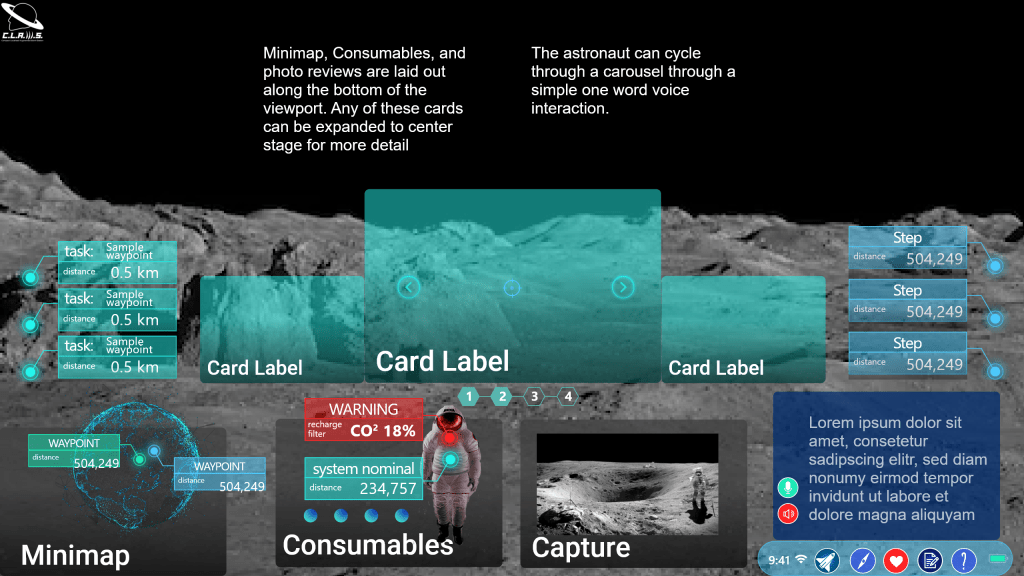
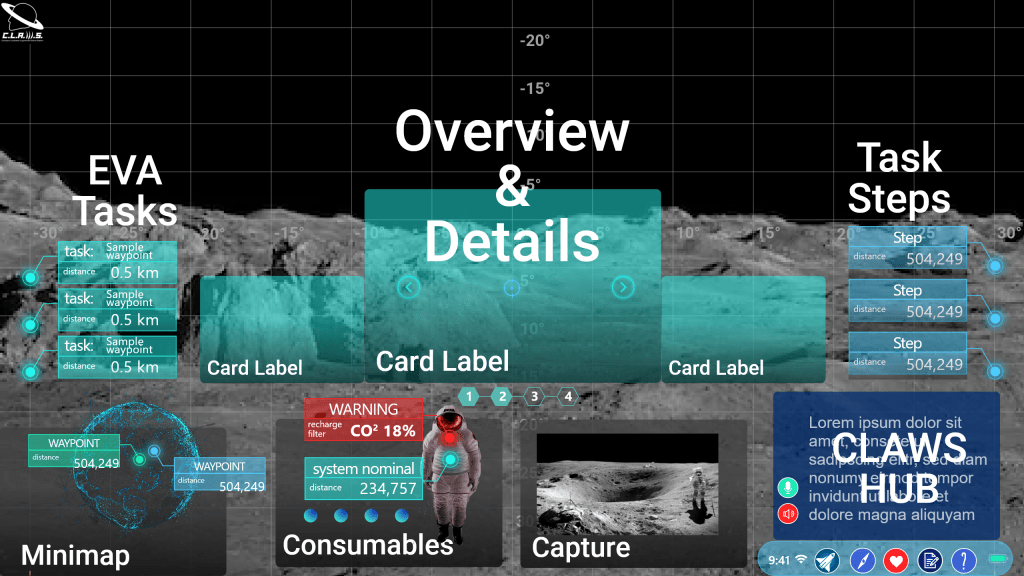
The AR Toolkit for Lunar Astronauts and Scientists (ATLAS) is an information system that was conceived during my time working in a software engineering lab at the University of Michigan.
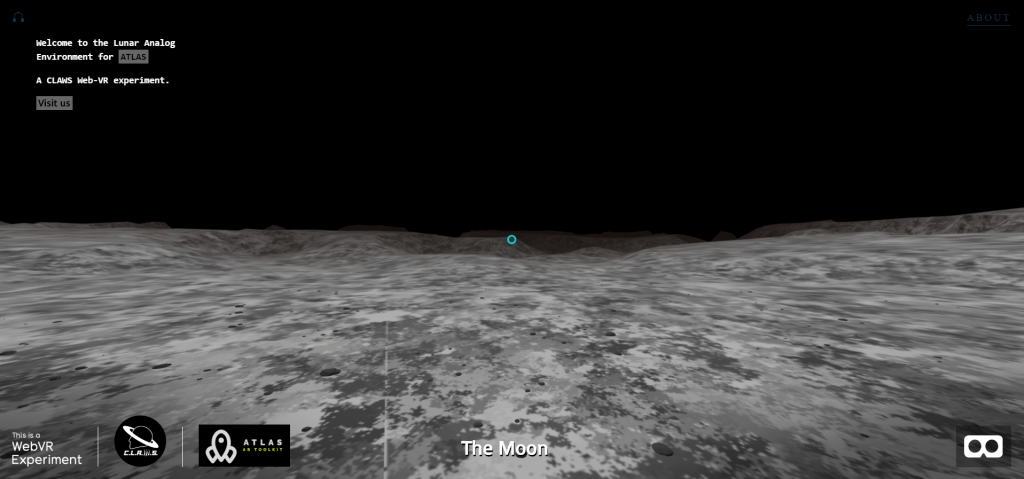
I led the UX Research, rapid prototyping, and human-in-the-loop testing for an augmented reality information system designed for use in the Artemis generation xEMU spacesuit during lunar EVAs, as well as VEGA (Voice Entity for Guiding Astronauts) a Rasa-based conversational AI.
ATLAS won the 2020 NASA SUITS Challenge, a $10k EPIC MegaGrant, and became the foundational system upon which the CLAWS lab continues to make leading edge technological advances to enable long duration human spaceflight.
This work was also utilized in the NASA Exploration Habitat (X-Hab) Challenge in collaboration with the Bioastronautics and Life Support Systems Lab at the University of Michigan.
The goal of ATLAS and VEGA are to assist astronauts in cognitively demanding fieldwork. Because of the nature of the work, I guided the UX toward emphasizing non-intrusiveness, adaptivity, and situational awareness.
This project led to:
Further involvement with BLiSS, leading human-centered design to adapt VEGA for NPAS, the NASA Platform for Automated Systems, in collaboration with NASA’s Autonomous Systems Laboratory.
An internship with NASA’s Exploration Medical Capability team where I worked across internal systems as a Human Factors Engineer and UI Architect to advance medical systems for long duration human spaceflight.
My thesis research, which synthesized these experiences to better understand the perception of human-centered design among tech-centered engineers designing systems for human spaceflight and the implications for designing the Future of Work on Earth and in Space.
Finally, my journey at NASA concluded with a tour of the aerospace side on the Convergent Aeronautics Solutions team to deliver human-centered design evangelism in support of advanced urban air mobility (eVTOL, drones, etc.) over the summer prior to entering the PhD program at the University of Michigan School of Information.
Publications & Outputs
 Matt Garvin, MSI
Leave a comment