Overview
As part of CLAWS, I contributed to the ATLAS project—an AR Toolkit for Lunar Astronauts and Scientists—a forward looking design research initiative sponsored through NASA’s SSERVI program and the NASA SUITS Challenge; as well as VEGA—Voice Entity for Guiding Astronauts. The project aimed to enhance human performance in extra-vehicular activity (EVA) using augmented reality interfaces, with the long-term goal of supporting scientific exploration on the Moon and Mars. This work was also used for NASA’s Exploration Habitat (X-Hab) Challenge in a collaboration with the Bioastronautics and Life Support Systems Lab at the University of Michigan.
ATLAS addressed a complex design challenge: how to assist astronauts in cognitively demanding fieldwork through tools that are non-intrusive, adaptive, and situationally aware. The work took place within a cross-disciplinary team spanning aerospace engineering, planetary science, human-computer interaction, and software development.
My Contributions
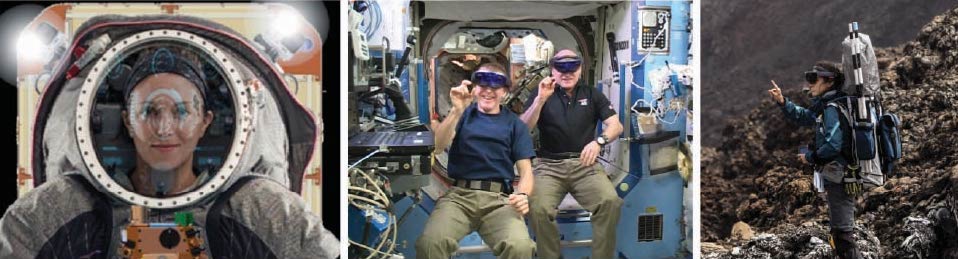
- Led user research and human-in-the-loop testing for spatial interfaces that supported geotagged data collection, mission task coordination, and real-time navigation on the lunar surface.
- Designed and prototyped a system of modular AR tools that supported distinct operational modes: pre-mission planning, in-field annotation and post-mission review.
- Contributed to the development of VEGA, a speculative conversational AI assistant designed to support astronauts via hands-free, voice-based commands during EVA.
- Developed interface flows for GeoNotes, a speculative spatial journaling system that allowed astronauts to place virtual annotations in 3D space.
- Supported remote user testing and evaluation planning, adapting traditional UX research methods to constraints of analog field testing and COVID-era remote validation.
Design Impact
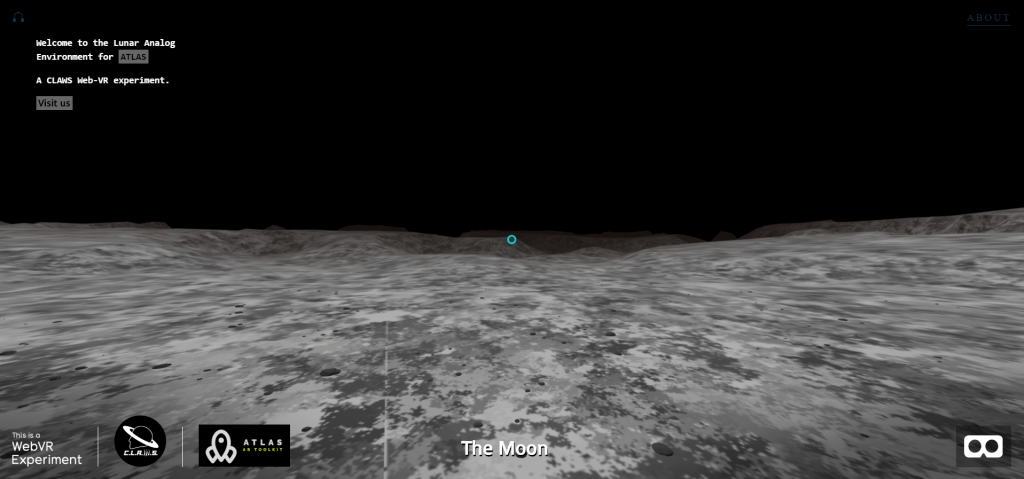
My work helped shape a design direction that moved away from monolithic interfaces and toward a toolkit-based approach, emphasizing flexibility, clarity, and context-awareness. The system prioritized minimal visual clutter, hands-free interaction, and cross-phase utility in a move toward making astronaut tools more usable, but also safe for mission-critical activities.
Tools & Techniques
- Design Tools: Adobe XD, Figma, Miro
- Prototyping Platforms: Unity, Microsoft HoloLens SDK
- Collaboration Stack: GitHub, Heroku, Django/PostgreSQL backend
- Methods: speculative prototyping, spatial interaction design, EVA workflow mapping, remote user feedback
Futures Thinking
My work with CLAWS was the first of several projects supporting astronaut autonomy, culminating in my thesis research. Astronaut autonomy is a deeply future-facing challenge. To date, astronauts have always been in constant contact with hundreds of subject matter experts at Mission Control. To extend our capabilities for human space exploration, to go to Mars for example, we must develop sufficient information systems, with adequately design interfaces, to replace the need for instantaneous communication with Earth in the event of an emergency.
Moreover, astronaut autonomy is a Future of Work problem. Today, astronauts are highly trained career pilots, engineers, or scientists. But we are already seeing commercial and civilian astronauts. In the future, many humans will work in space. Design those tools with me.
Publications & Outputs
 Matt Garvin, MSI